UMF improves student retention, workforce preparation by tripling enrollment in hands-on Research Learning Experiences
FARMINGTON, ME (February 11, 2026)—The University of Maine at Farmington (UMF) is strengthening student retention and workforce readiness thanks to an explosion of enrollment in high-impact, hands-on Research Learning Experiences (RLEs).
Since launching RLEs at UMF in the 2022-23 academic year, participation has tripled from 131 students enrolled in 12 courses to 465 students in 25 courses in 2025-26.
RLEs, which are uniquely offered at UMF and other institutions in the University of Maine System (UMS) through an investment from the Harold Alfond Foundation known as UMS TRANSFORMS, invite students to find their passion and make impactful connections through hands-on learning and the creation of new knowledge. Students engage in projects where they can learn by doing, express themselves artistically, contribute to a service initiative and take part in authentic inquiry through planning, data collection, analysis and reporting.
RLEs are typically for first-year students as they begin their college studies and have become a differentiator for Maine’s public universities when compared to peers that don’t typically offer opportunities for hands-on research learning until later. They are incorporated into high-impact activities and First Year Seminar courses. Students participating in these courses take personal ownership by completing a student-directed inquiry project that allows them to explore research questions, engage in discovery and develop critical thinking skills.
It’s part of a larger effort by UMF to improve student enrollment, outcomes and the readiness of graduates for success in the Maine workforce. UMF’s spring semester enrollment is 3.6% higher than one year ago, and since integrating RLEs and other strategies like the Student Learning Commons, UMF’s retention rates have rebounded to their highest levels since 2009.
“We are grateful to the Harold Alfond Foundation for giving our students the opportunity to engage in experiential research opportunities. By exploring methods of inquiry, our students become life-long learners,” said UMF President Joseph McDonnell. “These innovative research courses prepare our students for professional careers with the intellectual and social skills they’ll need to be successful after college.”
Advanced RLEs (ARLEs) are offered to sophomores and higher and are generally more specific to their majors. These courses are offered across academic programs and engage students with external partners such as business leaders, research leaders and professionals in the field. These experiences often lead to internships, clinicals or other pre-professional student experiences, providing students with resume and career building proficiencies.
Student Researchers Investigate Real World Issues
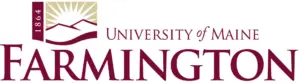
UMF biology professor Donelle Schwalm’s course on tick research is one of many ARLE courses offered at UMF. Students enrolled in the course learn about the impact these invasive arachnids are having in Maine and are either in the field gathering tick samples or in the lab identifying and testing the samples for further study.
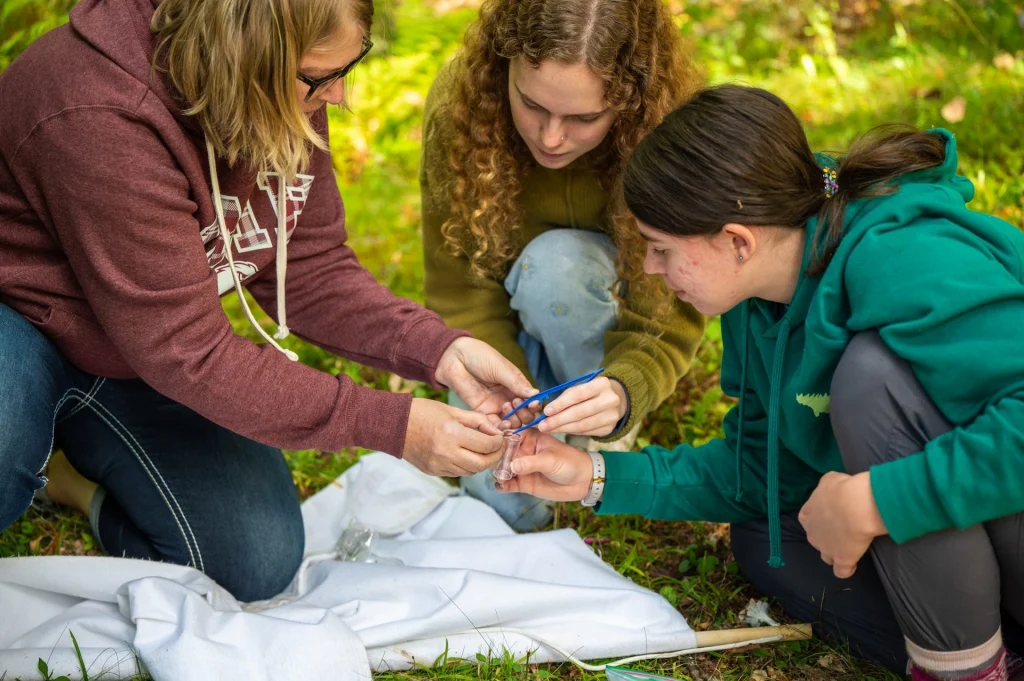
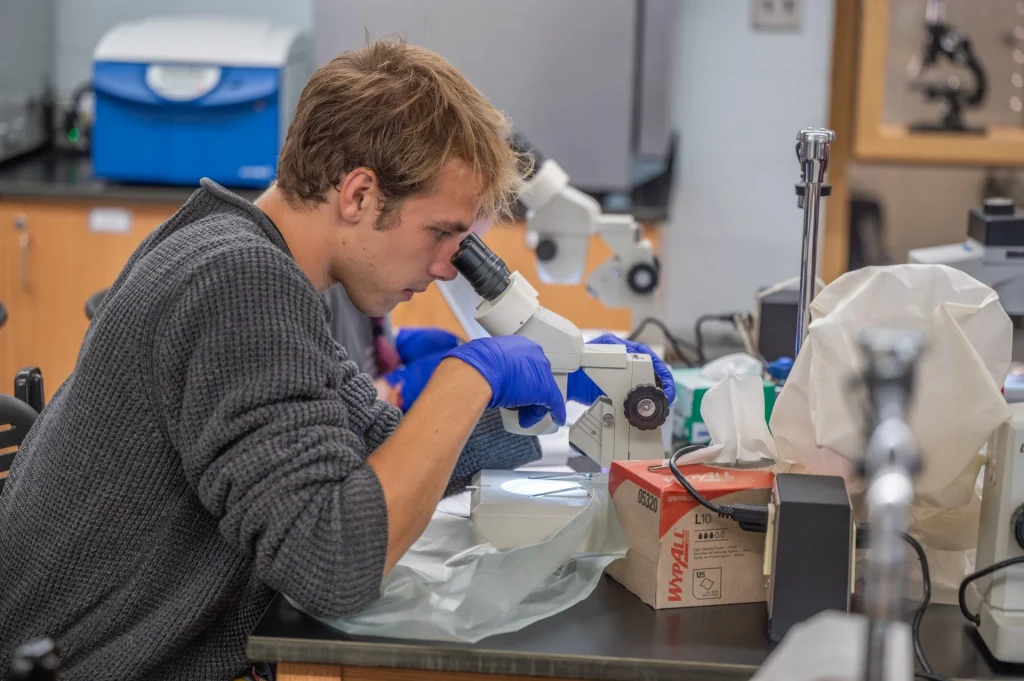
Students begin by designing a working collection method and then drag for ticks on prearranged private and public property in the Farmington area. These samples are then taken to the UMF lab where they are frozen, identified and pulverized to obtain the DNA and determine if they are carrying any of the diseases, including Lyme, which are most common in Maine.
Throughout Schwalm’s course, students have the opportunity for professional development and career exploration. They visit the University of Maine Cooperative Extension Diagnostic and Research Laboratory in Orono that runs the tick testing lab for the state of Maine and meet with Assistant Extension Professor Tom Rounsville, an expert in DNA testing.
“My ARLE expanded my career interests in disease ecology and I am excited about working in the scientific field,” said Ryan Martin-Hachey, a UMF senior from Fairfield majoring in biology with minors in data analysis and psychology. “I have worked as a pathology technician for the Maine Department of Marine Resources, and following an ARLE course researching tick zoonosis, I am currently looking to work at a hospital post-graduation as a histotechnologist testing samples from patients for diseases.”
In addition to learning about career opportunities, Schwalm’s students also build communication skills with their peers, experience writing a scientific manuscript and learn about potential career pathways from successful alumni.
“The best part for me is seeing students excited about the major they’ve chosen and what comes next,” said Schwalm. “Science careers offer so many opportunities today and it’s great to have a program that helps students see their career potential.”
UMS TRANSFORMS is the overarching name of the multi-year, System-wide initiative funded by $320 million from the Harold Alfond Foundation that focuses on four key areas, including student success and retention, which supports RLEs and ARLEs.
This historic investment represents a strategic, long-term effort to strengthen the capacity of Maine’s public universities to meet the state’s higher education, workforce and economic development needs.
For more information on RLEs at UMF, contact Austin French, director of Career Pathways and Employer Engagement at austin.french@maine.edu.
More on University of Maine at Farmington
A nationally recognized regional public university, the University of Maine at Farmington is known for its commitment to teacher preparation, the creative arts, health and science, environmental studies, business and public service. Located in the heart of Maine’s four-season outdoor recreational region, UMF provides a challenging but welcoming academic community—here in Farmington and online—that prepares students for enriching professional careers, engaged citizenship and an enduring love of learning.
# # #
EDITOR’S NOTE:
Image: https://farmington.edu/app/uploads/2026/02/RP256-022A.webp
Photo Caption: (Left to right) UMF biology professor Donelle Schwalm helps students Claire Beisel, and Cora Treiss collect a tick from a tick drag cloth that will be tested for tick borne diseases in the lab.
Photo Credit: UMF Image
Image: https://farmington.edu/app/uploads/2026/02/RP256-022B.webp
Photo Caption: UMF student Emmet Lani-Caputo uses a dissecting microscope to identify a tick to species, sex, and age class prior to tick zoonosis testing.
Photo Credit: UMF Image
Share this article: