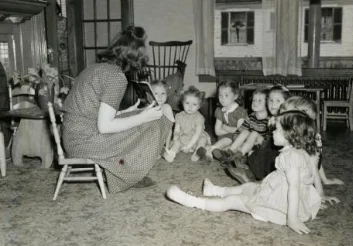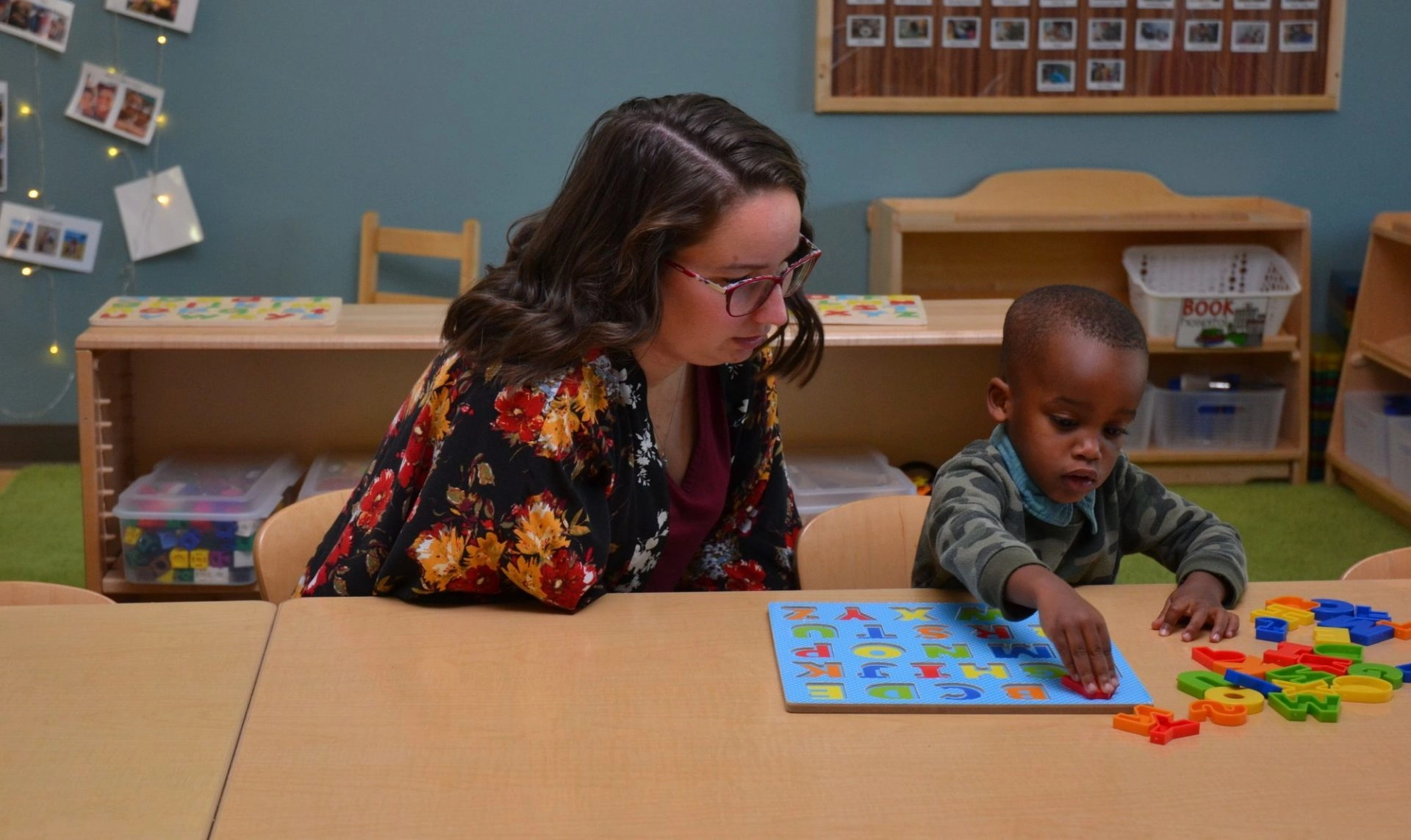
Early Childhood Education (M.S. Ed.) students gather around classroom table.

Master’s in Early Childhood Education (M.S.Ed.)

Shape Young Minds

Invest in yourself and unlock your potential to become an exceptional leader, inspiring positive change and making a lasting impact in your field.

The University of Maine at Farmington offers the state’s only Maine-based Master of Science in Education (M.S.Ed.) in Early Childhood, designed for professionals seeking to become exceptional leaders in the field. Graduates are prepared to excel as educators, trainers, classroom teachers, administrators, policy advocates, curriculum specialists, and program developers.

Through a creative and diverse curriculum, students develop the skills to collaborate with community agencies and professionals while benefiting from rigorous coursework and faculty mentorship. The program emphasizes excellence in practice and research, with a strong focus on addressing diversity and fostering leadership in early childhood education.

Early Childhood Education Master’s Curriculum

The M.S.Ed. in Early Childhood curriculum is carefully designed to contribute to the intellectual and professional growth of those who work with children ages birth through age 8. The program emphasizes child development-based curriculum, development, and assessment across ages birth through age 8, as well as an understanding of the family and community contexts in which these children are educated.

I knew I wanted a leadership position here at Educare and getting my Master’s degree in Early Childhood Education would set me up for that. The Master’s program at UMF gave me everything I needed – advanced knowledge about child development, best practices in family engagement, how to be a professional and how to really advocate policy.
Erica Palmer
Education Manager at Educare of Central Maine

UMF Master’s in Early Childhood Education

UMF’s Master of Science in Early Childhood Education (M.S.Ed.) prepares professionals to become leaders in the field. Through a blend of rigorous coursework, faculty mentoring, and hands-on experiences, students develop the skills to excel as educators, administrators, curriculum specialists, and advocates for young children, with a strong emphasis on collaboration, diversity, and community engagement.

Core Curriculum (21 credits)

  • ECH 500 Early Childhood Education in Today’s World
  • ECH 533 Advanced Foundations of Child Development
  • ECH 535 Play and Early Learning Requirements
  • ECH 538 Collaboration with Families and Communities
  • ECH 539 Curriculum Development and Assessment
  • ECH 540 Research Methods in Early Childhood
  • ECH 541 Field-Based Research

To see course descriptions please review the Graduate Catalog.

Concentrations

Individualized

Take any of the following electives as they are offered for a well-rounded course of study in Early Childhood.

Courses

  • ECH 502 Diverse Programming in Early Learning Environments
  • ECH 534 Policy and Leadership in Early Childhood
  • ECH 505 Mathematics in the Early Childhood Years
  • ECH 506 Language and Literacy in the Early Years
  • ECH 507 Advanced Infant and Toddler Development and Curriculum
  • ECH 537 Science in the Early Childhood Years
  • ECH 577 Special Topics in Early Childhood Education
Nature-Based Education

This concentration is designed for educators interested in connecting their students with the natural world around them and developing hands-on learning experiences.


Required Courses

  • EDU 539 Introduction to Nature Based Education and Outdoor Learning
  • EDU 520: Nature-Based Programming and Leadership
  • ENV 577: Natural History of Maine/New England

Choose two electives from the following courses

  • EDU 559: Outdoor Classroom Design
  • EDU 549 Design Thinking for Early Learners and Elementary
  • EDU 508 Nature-Based Art Education
  • EDU 514 Exploring Maine Through Children’s Literature
  • EDU 555: Integrating Nature into the Curriculum
STEAM for Early Childhood and Elementary Educators

This concentration is designed for educators who want to explore the integration of Science, Technology, Engineering, Arts and Math (STEAM) in their classrooms in order to nurture creativity and critical thinking skills in early and elementary learners.


Required Courses

  • Engineering for Early Learners and Elementary
  • Introduction to STEAM for Early Learners and Elementary
  • Design Thinking for Early Learners and Elementary

Choose two electives from the following courses

  • Computational Thinking for Early Learning and Elementary
  • Technology for Young Learners
  • Advanced Mathematics Methods for Elementary School Teachers
  • Exploring Maine Through Children’s Literature
  • Science in the Early Childhood Years
  • Creative Arts in Early Education

Maximize Your Education

The University of Maine at Farmington offers nationally recognized graduate programs designed to help teaching professionals advance their careers. UMF provides seven on-campus Master’s degrees, 10 Graduate Certificates, a fully online Master’s program, a Special Education Alternative Route to Certification, and the new Master’s in Counseling Psychology with a Creative Arts Focus.

Through its Division of Graduate & Continuing Education, UMF partners with Maine’s Pre K–12 schools to develop high-quality programs that meet current educational needs. All programs are backed by UMF’s strong reputation in teacher education and accredited by the New England Commission of Higher Education (NECHE).

How to Apply

To apply for the M.S.Ed. in Early Childhood, you will need to provide the following:

Prerequisites

In order to apply, you must have a baccalaureate degree in Early Childhood Education or a closely related field from a regionally accredited college or university OR a baccalaureate degree in a non-related field OR in an education field outside of the early childhood years.

If you have a non-Early Childhood Education degree, you must provide a clear rationale for relevant preparation to enter the Early Childhood program at an advanced level of study. See Supplementary Essay below for details.
If you have a foreign degree, it must be validated by World Educational Services, Center for Educational Documentation, Inc., or another appropriate agency. The decision to accept the degree is made on a case-by-case basis by the Associate Dean for Graduate and Continuing Education.
You must also have access to active programs for children and families in order to complete field experiences, including research projects.

Application

Online Application>>

Please email completed forms to: gradstudies@maine.edu

Transcripts

Please provide official transcripts from each institution you have attended (including both the undergraduate and graduate level). Official transcripts must be sent directly from the institutions to the UMF’s Office of Graduate Studies. If you attended a UMaine System school (UMA, UMF, UMFK, UMM, UM, UMPI, or USM), the Office of Graduate Studies can obtain your transcript for you.

Essay

Applicants must submit an essay that will be reviewed by the Graduate Admission Committee to evaluate your ability to organize your thoughts and write clearly, correctly, and creatively at a level required for graduate study. We consider your essay an important piece of information to help us make a decision.

Your essay will be evaluated for content and professional writing style, grammar, spelling, and vocabulary. 500 word limit. Please address all of these topics:

  • Self Assessment: Analyze the strengths, including career and leadership experience, that will contribute to your success in UMF’s master’s program. Articulate the knowledge and skills you wish to develop further.
  • Vision and Values: Describe your vision of high quality early childhood education in today’s world and the values that guide your work with young children and the families.
Supplemental Essay

If you did not complete an undergraduate degree in early childhood or a closely related field (i.e. child development, early childhood special education, human development), you must submit an additional essay in response to the following prompts. 500 word limit.

Please address all topics.

  • Describe a clear rationale for relevant preparation to enter an early childhood program at an advanced level of study (such as foundational knowledge and/or knowledge of current issues in the field)
  • Summarize your work experience with children and families in birth to age eight programs.
Recommendation Forms

Two recommendation forms are required:

These individuals should know you in a professional or educational context and speak to your abilities for graduate study.
Download Recommendation Form>>

Note: This is a fillable form, and you may need to download it to enable it.

Background Screening

Most courses require some direct contact with children, through observations, projects, and/or research. You will need to have a clear criminal history and child abuse and neglect check and provide current documentation to the Office of Graduate Studies. Any fee incurred will be your responsibility.

Documentation may be:
Option 1: Two documents

  • Maine Department of Health and Human Services clear check of substantiated Maine Child Protective Services Cases (This check must be initiated by the agency where you are employed.) AND
  • Maine State Bureau Identification Maine Criminal History Check (This check can be obtained on your own.)

Option 2:

  • Copy of current Maine DOE public teaching certification that indicates a Criminal History Check has been conducted.

Option 3:

  • Copy of Initial Educational Approval from Maine DOE that indicates a Criminal History Check has been conducted
Transfer Policy

If you are requesting that graduate-level coursework be transferred from another institution into this UMF Master’s program, in addition to your transcript you must submit the syllabi for each course you would like considered for transfer. Transfer decisions are made at the time of admission.

A student, with the approval of the Admissions Committee, may transfer up to 9 graduate credits from another institution into his/her academic program; only 3 of these credits may be in the core of the program. These credits must have been earned from a regionally accredited institution, within 5 years prior to admission, and with a minimum grade of B (or equivalent). Graduate credits applied toward an undergraduate degree cannot be used toward the Master’s degree.

Contact Us to Get Started!

Division of Graduate & Continuing Education
University of Maine at Farmington
Theo Kalikow Education Center
186 High Street
Farmington, Maine 04938