
Exploring the Aquifer of Mexico’s Yucatán Peninsula in the Digital Age
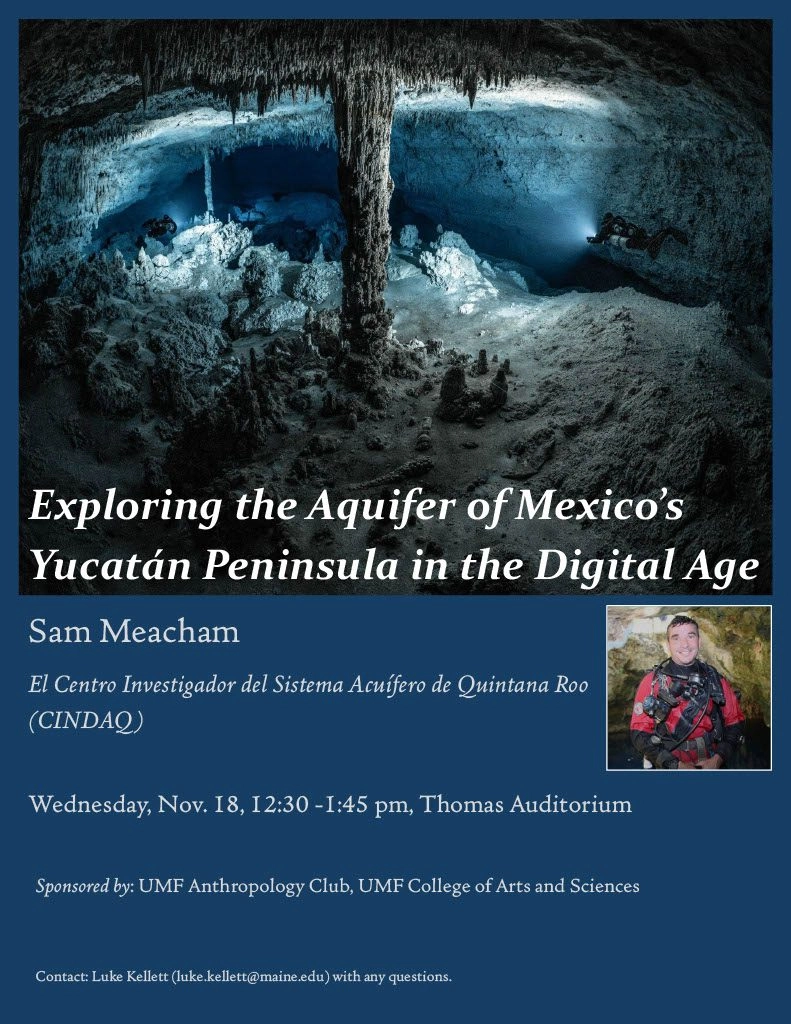
Meacham is an explorer, researcher, and conservationist with over 30 years of experience exploring and documenting the underwater caves, cenotes, and karst landscapes of Mexico’s Yucatán Peninsula. His work combines cave exploration, archaeology, paleontology, hydrogeology, geospatial science, and conservation.
Meacham holds an M.S. in Natural Resources, specializing in Remote Sensing of the Environment, from the University of New Hampshire. His fieldwork includes coordinating and participating in numerous expeditions, notably the exploration of Sistema Ox Bel Ha, the world’s second-longest cave system, entirely underwater, and investigations of prehistoric archaeological sites such as La Mina, a 12,000-year-old submerged ochre mine. Sam is a National Geographic Explorer, a Fellow of the Explorers Club and the Royal Geographical Society, a National Geographic Adventurer of the Year honoree (2007), and a NASA Space Grant Fellow.
Meacham founded El Centro Investigador del Sistema Acuífero de Quintana Roo (CINDAQ) in 2000 and continues to serve as its Director. CINDAQ is a Mexican nonprofit dedicated to the research, documentation, and conservation of the region’s aquifer and its associated natural and cultural heritage. Over more than two decades of field research, CINDAQ has developed extensive expertise in managing complex exploration and scientific datasets and integrating them within geographic information systems (GIS). This expertise is increasingly sought by research and conservation organizations around the world seeking to improve the management, integration, and long-term preservation of field data.
Contact: Luke Kellett, Professor, Department of Anthropology, luke.kellett@maine.edu
Share: