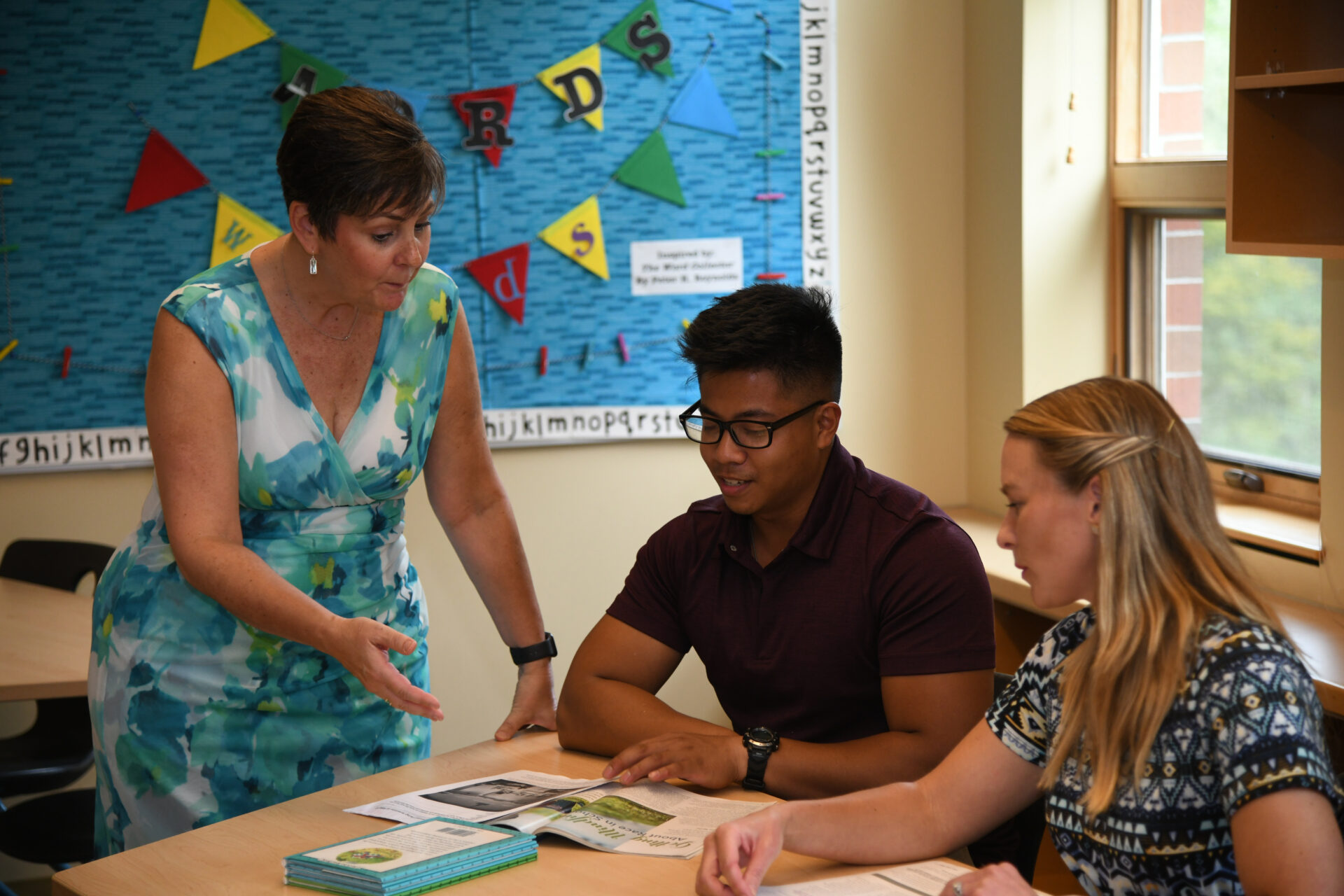
UMF Special Education graduate students reads book

Master’s in Special Education (M.S. Ed.)

Master’s in Special Education (M.S. Ed)

Advance your career and make a lasting impact with UMF’s Master’s in Special Education.

The University of Maine at Farmington’s Master’s in Special Education (M.S. Ed.) is designed for educators who are passionate about making a difference in the lives of students with diverse learning needs. This program provides the advanced knowledge and skills needed to design, deliver, and evaluate high-quality special education services that improve student outcomes.

Through a combination of research-based coursework and practical experience, students will deepen their expertise in areas such as inclusive practices, individualized instruction, behavior management, and collaboration with families and professionals. Whether you are looking to advance in your current role, move into leadership, or expand your ability to serve students with disabilities, UMF’s program prepares you to lead with confidence and compassion.

UMF's Early Childhood Education is ranked in the Top 5 Best Master's Programs in Maine 2024
UMF’s Early Childhood Education is ranked in the Top 5 Best Master’s Programs in Maine 2024

Among Maine’s Top Master’s Degree Programs

UMF is rated by University Headquarters as having some of the Best Master’s Degrees in Maine (#2 overall). University Headquarters is an industry-leading, independent educational organization that compiles a comprehensive set of information for students who wish to pursue an advanced degree.

Flexible Learning: Online Convenience with In-Person Connection

UMF’s Master’s in Special Education offers a blended format designed to fit the busy lives of working professionals. With roughly 70% of coursework completed online and 30% taught in person, you’ll enjoy the flexibility of online learning without losing the valuable benefits of face-to-face instruction. The in-person component typically meets three Saturdays per semester, giving you the chance to connect, collaborate, and learn alongside your peers in a focused, engaging environment.

Graduates consistently highlight this model as the best of both worlds. The online courses provide the convenience to study on your schedule, while the in-person sessions foster meaningful connections with faculty and fellow educators. Together, these experiences not only strengthen your knowledge and skills but also expand your professional network—something that lasts long after graduation.

About this Program

What’s the Curriculum like?

The Master’s in Special Education (M.S. Ed.) program is structured around 33 graduate credit hours. This includes 12 credit hours of rigorous core curriculum and the choice between 5 Specializations that are 21 credit hours each.

Core Curriculum Requirements: 12 credits

  • SED 551: Advanced Intervention Methods
  • SED 598: Inclusive Education Reform: a Social Justice Approach to School and Systemwide Reform
  • EDU 582: Research Methods in Education
  • SED 586: Special Education Research
  • Internship (varies, based on Specialization)

To see course descriptions please review the Graduate Catalog.


Teacher Certification Track

The Teacher Certification Track specialization is designed for in-service and pre-service educators seeking certification as a teacher of students with disabilities (282 certification). Courses are chosen in consultation with your academic advisor to ensure state certification requirements are met and professional goals are reached.

Courses

  • SED 503 Preparing Students for the Future: Transition programming, self-determination and advocacy (required for 6-12 certification)
  • SED 505 Universal Design for Learning and Curriculum Access
  • SED 506 Assessment in Special Education
  • SED 507 Curriculum and Instructional Programming for Students with Disabilities
  • SED 508 Classroom and Behavior Management of Students with Disabilities
  • SED 511 Mathematics Instruction for Students with Disabilities
  • SED 513 Early Childhood Speech and Language: Development, Disorders, and Interventions
  • SED 514 Literacy Development for All Students
  • SED 518 Special Education Law
  • SED 529 Individualized Positive Behavior Supports

To see course descriptions please review the Graduate Catalog.


Inclusive Special Education and Leadership

This specialization prepares students to work in K-12 schools and other education-centered contexts in a variety of inclusive roles. We develop teachers, leaders, and change-agents who can effectively assess students and understand diverse needs, develop instruction and supports that are universally designed and differentiated, understand multicultural perspectives, and collaborate with colleagues and communities to increase inclusion for youth who struggle or who have traditionally been marginalized.

This program helps prepare educators to further lean into their current roles or for future careers as:

  • inclusive special or general education classroom teachers
  • inclusive education specialist or consultants
  • teacher leaders and department chairs
  • inclusive specialists at research and advocacy organizations
  • inclusive specialists at community centers, agencies, or non-profit organizations
  • school administrators.*

* Note: This specialization does not lead to Maine’s Special Education administrator certification; students interested in Special Education Administration should consider our Special Education Administrator specialization.

Courses

  • SED 598 Inclusive Education Reform: a Social Justice Approach to School and Systemwide Reform
  • SED 599 Advanced Inclusive Ed: Gaining Access to Inclusive Education and Community
  • EDU 579 Implementing an Integrated Multi-Tiered System of Supports
  • EDU 551 Changing Educational Organizations in a Diverse World
  • 4 Electives from the graduate catalog

And one of the following:

  • 508 Classroom and Behavior Management of Students with Disabilities
  • SED 504 Collaborative Partnerships Among Individuals with Disabilities, Families, and Professionals
  • SED 505 Universal Design for Learning
  • SED 519 Assistive Technology
  • SED 514 Literacy Development for All Students
  • SED 517 Professional Ethics, Cultural Competence, and Evidence-Based Practices in Early Intervention and Early Childhood Special Education
  • SED 515 Early Intervention: Working with Infants and Toddlers with Disabilities and Their Families

To see course descriptions please review the Graduate Catalog.


Special Education Administration

This specialization provides the prerequisite courses, knowledge base, and internship experience needed to be certifiable as a Special Education Administrator. Candidates will develop an understanding of the theoretical bases and practical application of Special Education Administration and be well-prepared to lead effective, inclusive Special Education programs. Upon completion of the program, graduates are eligible to be certified as a Special Education Administrator in the state of Maine (035 certification).

Courses

  • EDU 550 School Law for Administrators
  • EDU 551 Changing Educational Organizations in a Diverse World
  • EDU 552 Supervision and Evaluation of School Personnel
  • EDU 553 Finance for School Administrators
  • EDU 554 Internship in School Leadership

To see course descriptions please review the Graduate Catalog.


Self-Designed

Students seeking in-depth study on a specific topic or topic in the field of special education will work with an advisor to develop a program plan. Students identify a Self-Designed specialization and propose courses to complete to fulfill requirements for the self-designed specialization. Self-designed specializations may include, for example: literacy in special education, special education research, emotional/behavioral disorders, multi-tiered systems.


Low Incidence Disabilities

In partnership with the University of Maine, the Low Incidence Disabilities specialization focuses on preparing educators to deliver high quality, inclusive educational services, supports, and interventions to students with extensive support needs including physical disabilities, intellectual disabilities, and autism. Upon completion of the program, students are eligible for state certification as a teacher of students with low incidence disabilities (286 certification).

What’s the Application Process?

All applicants are strongly encouraged to contact the Division of Graduate & Continuing Education office prior to application to discuss the program and professional goals. Call us at 207-778-7502 or email us at gradstudies@maine.edu.

Applications are accepted on a rolling basis, and will be considered when complete. Students may enroll in some courses as a non-matriculated student prior to acceptance into the program.

Due Dates

  • Spring Term: December 9
  • Summer Term: April 24
  • Fall Term: August 14

How to Apply

To apply for the M.S.Ed. in Special Education, you will need to provide the following to the Division of Graduate & Continuing Education:


Prerequisites

Applicants must have a baccalaureate degree from a regionally accredited college or university. A foreign degree must be validated by World Educational Services, Center for Educational Documentation, Inc., or other appropriate agency. The decision to accept the degree is made on a case-by-case basis by the Associate Dean for Graduate and Continuing Education.

Application

Online Application >

Please email completed forms to: gradstudies@maine.edu


Transcripts

Please provide official transcripts from each institution you have attended (including both the undergraduate and graduate level). Official transcripts must be sent directly from the institutions to the UMF’s Office of Graduate Studies. If you attended a UMaine System school (UMA, UMF, UMFK, UMM, UM, UMPI, or USM), the Office of Graduate Studies can obtain your transcript for you.


Essay

We are looking for candidates with the potential to work effectively with students with disabilities in K-12 schools and ensure their meaningful access to a high quality, inclusive education.

Please write a brief (1,000 word limit) essay in which you discuss your academic and professional goals and identify how this degree program addresses those goals.


Recommendation Forms

Two recommendations are required.

  • One from a current administrator (assistant director/director of Special Education, assistant principal/principal)
  • One from a professional colleague of your choosing
  • 4+1 applicants – One recommendation must be from a university faculty member or recent supervisor/administrator who can speak to your potential for completing graduate work.
  • Please provide each reference with a copy of the blank recommendation form.

Download Recommendation Forms>>

Note: This is a fillable form, and you may need to download it to enable it.


Maine DOE Certification

Please submit a copy of your Maine DOE certification.


Requesting a Self-Designed Specialization?

If you are requesting a self-designed specialization, then you will need to provide us with supplemental information.

Please submit the following additional information as part of your application essay:

  • Propose a title for the focus of your specialization (e.g., behavior supports, low incidence disabilities, transition, mathematics).
  • List the courses you have taken that you are requesting for transfer. Include course prefix, title, institution, and grade received. (Official transcripts and syllabi are required for final decision regarding transfer of credit.)
  • List the courses you may take at UMF to complete the specialization (refer to UMF’s graduate catalog).
  • What knowledge and skills do you hope to obtain? How would this focus promote your growth as a special educator? Identify the specific areas (1-2) of expertise (e.g., transition services, literacy, mathematics, behavior supports) you would hope to develop as part of this self-designed option.


Transfer Policy

If you are requesting that graduate-level coursework be transferred from another institution into this UMF Master’s program, in addition to your transcript you must submit the syllabi for each course you would like considered for transfer. Transfer decisions are made at the time of admission.

These credits must have been earned from a regionally accredited institution, within 5 years prior to admission, and with a minimum grade of B (or equivalent). Graduate credits applied toward an undergraduate degree cannot be used toward the Master’s degree.


Advance Your Career with Graduate Programs at UMF

The University of Maine at Farmington (UMF), nationally recognized for excellence in teacher education, offers a wide range of graduate opportunities designed for education and counseling professionals. UMF provides five on-campus master’s degree programs, 10 graduate certificate options, a fully online master’s program, a Special Education Alternative Route to Certification, and a new Master’s in Counseling Psychology with a Creative Arts Focus. Through the Division of Graduate & Continuing Education, UMF partners closely with Maine’s Pre K–12 schools to deliver programs that are responsive to evolving educational needs. Accredited by the New England Commission of Higher Education (NECHE), UMF ensures students receive a high-quality, impactful education.

How to Apply

To apply for the M.S.Ed. in Special Education, you will need to provide the following to the Division of Graduate & Continuing Education:

Prerequisites

Applicants must have a baccalaureate degree from a regionally accredited college or university. A foreign degree must be validated by World Educational Services, Center for Educational Documentation, Inc., or other appropriate agency. The decision to accept the degree is made on a case-by-case basis by the Associate Dean for Graduate and Continuing Education.

Application

Online Application >

Please email completed forms to: gradstudies@maine.edu

Transcripts

Please provide official transcripts from each institution you have attended (including both the undergraduate and graduate level). Official transcripts must be sent directly from the institutions to the UMF’s Office of Graduate Studies. If you attended a UMaine System school (UMA, UMF, UMFK, UMM, UM, UMPI, or USM), the Office of Graduate Studies can obtain your transcript for you.

Essay

We are looking for candidates with the potential to work effectively with students with disabilities in K-12 schools and ensure their meaningful access to a high quality, inclusive education.

Please write a brief (1,000 word limit) essay in which you discuss your academic and professional goals and identify how this degree program addresses those goals.

Recommendation Forms

Two recommendations are required.

  • One from a current administrator (assistant director/director of Special Education, assistant principal/principal)
  • One from a professional colleague of your choosing
  • 4+1 applicants – One recommendation must be from a university faculty member or recent supervisor/administrator who can speak to your potential for completing graduate work.
  • Please provide each reference with a copy of the blank recommendation form.

Download Recommendation Forms>>

Note: This is a fillable form, and you may need to download it to enable it.

Maine DOE Certification

Please submit a copy of your Maine DOE certification.

Requesting a Self-Designed Specialization?

If you are requesting a self-designed specialization, then you will need to provide us with supplemental information.

Please submit the following additional information as part of your application essay:

  • Propose a title for the focus of your specialization (e.g., behavior supports, low incidence disabilities, transition, mathematics).
  • List the courses you have taken that you are requesting for transfer. Include course prefix, title, institution, and grade received. (Official transcripts and syllabi are required for final decision regarding transfer of credit.)
  • List the courses you may take at UMF to complete the specialization (refer to UMF’s graduate catalog).
  • What knowledge and skills do you hope to obtain? How would this focus promote your growth as a special educator? Identify the specific areas (1-2) of expertise (e.g., transition services, literacy, mathematics, behavior supports) you would hope to develop as part of this self-designed option.
Transfer Policy

If you are requesting that graduate-level coursework be transferred from another institution into this UMF Master’s program, in addition to your transcript you must submit the syllabi for each course you would like considered for transfer. Transfer decisions are made at the time of admission.

These credits must have been earned from a regionally accredited institution, within 5 years prior to admission, and with a minimum grade of B (or equivalent). Graduate credits applied toward an undergraduate degree cannot be used toward the Master’s degree.
Contact Us

Division of Graduate & Continuing Education
University of Maine at Farmington
Theo Kalikow Education Center
186 High Street
Farmington, Maine 04938