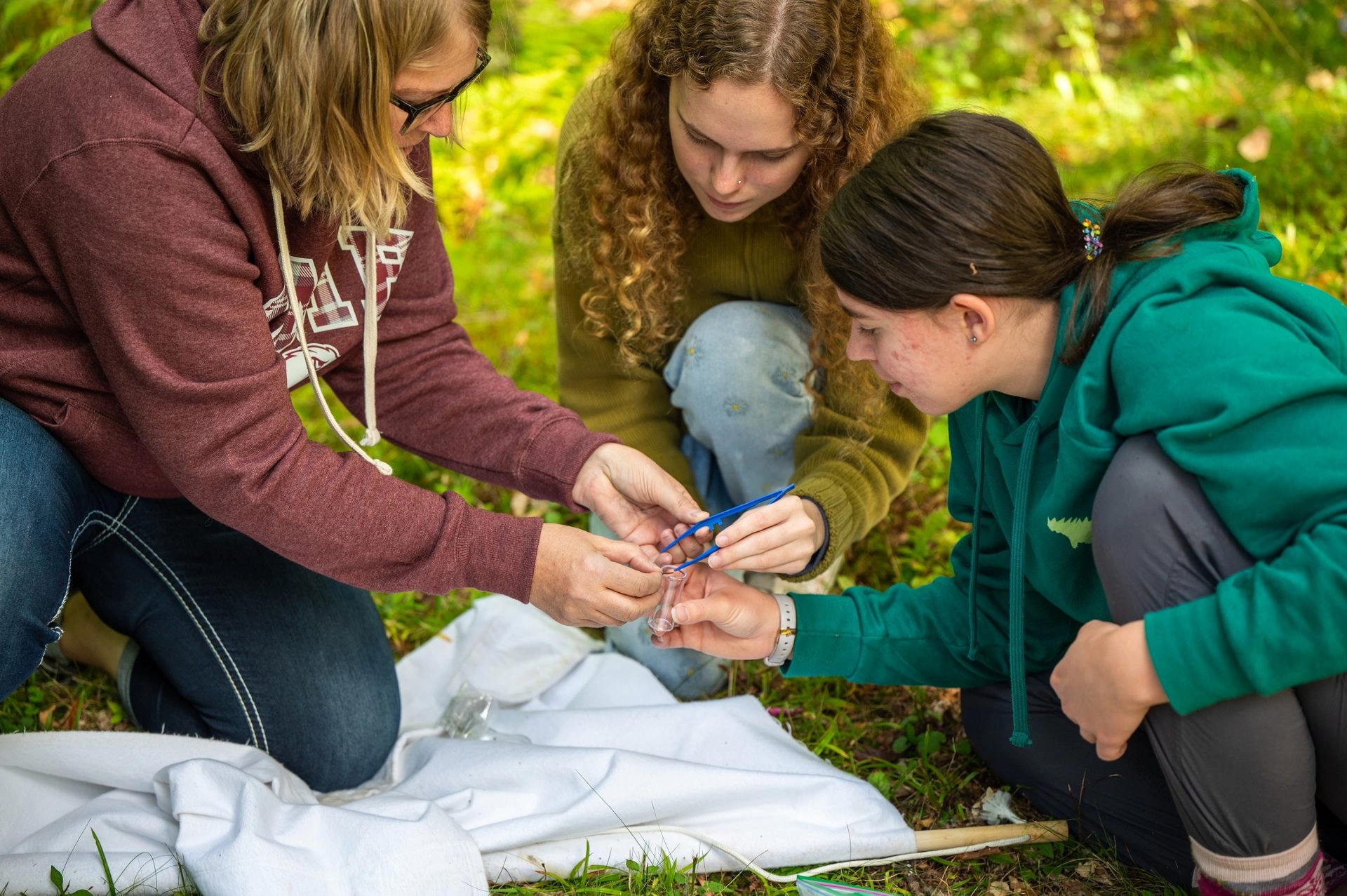
UMF biology professor helps students collect a tick from a tick drag cloth

Earth and Environmental Sciences

B.S. Degree with a major in Earth and Environmental Sciences

Explore the Planet, Shape the Future

At UMF, Earth & Environmental Sciences students join a close-knit community, gaining hands-on skills in field observation, sampling, and analysis.

At the University of Maine at Farmington, Earth and Environmental Sciences students work closely with professors in classrooms, labs, and the field. You’ll conduct real-world research in nearby forests, lakes, rivers, mountains, and coastal areas, gaining valuable skills while exploring diverse environments.

The program combines in-the-field and in-the-lab investigations to help you understand the Earth’s past, present, and future systems. You’ll also have opportunities for hands-on internships, building both technical and communication skills — including presenting your work in public and professional settings — to prepare you for a successful career in science.

Two Paths, One Passion for Discovery

UMF’s Earth and Environmental Sciences program offers two hands-on, field-focused concentrations: Geology and Environmental Science.

The Geology concentration explores the processes that shape our planet, with field experiences ranging from local sites to geologically rich destinations like Newfoundland, Ireland, Scotland, and Canada. Graduates often pursue careers in mineral exploration, water resource management, education, and GIS analysis.

The Environmental Science concentration takes a flexible, interdisciplinary approach grounded in natural sciences and mathematics, allowing for specialized study. Career opportunities include lake conservation, environmental assessment, endangered species protection, sustainable agriculture, and air quality or energy resource management, as well as preparation for graduate school.

Featured Field Research Projects

Maine Mountain Ponds Project

The Maine Mountain Ponds project engages students in hands-on ecological research, studying climate change impacts on northern Appalachian mountain watersheds while contributing valuable data to regional conservation efforts.

Tick-Borne Disease Research Initiative

UMF students and faculty research ticks and tick-borne diseases through field collection and lab analysis, helping address a growing public health concern in Maine while providing hands-on research experience in biology and environmental science.
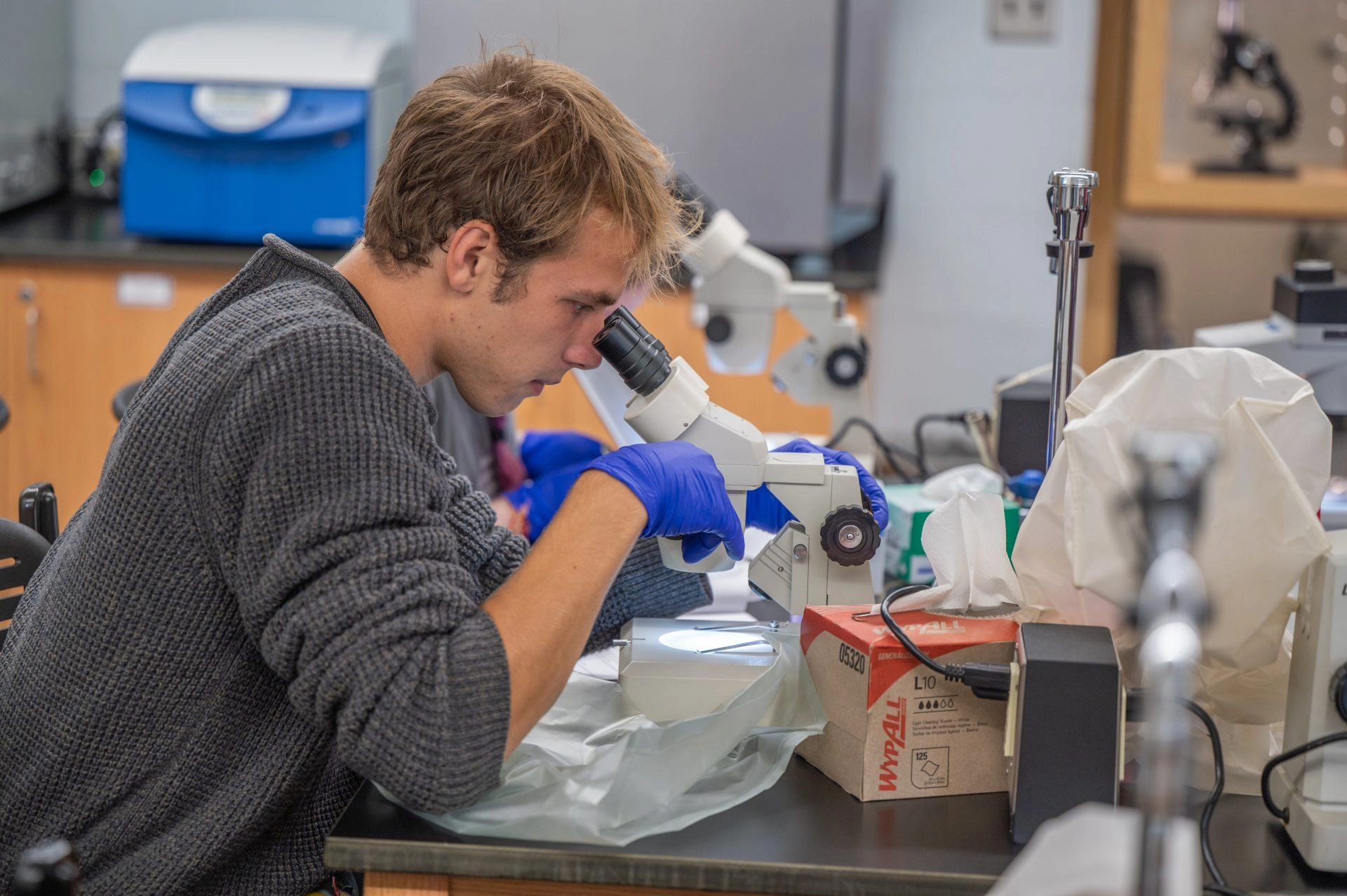
UMF student Emmet Lani-Caputo uses a dissecting microscope to identify a tick to species, sex, and age class prior to tick zoonosis testing.

What Can I Do With A Degree in Earth & Environmental Science?

No matter which Earth and Environmental Sciences concentration you choose, UMF prepares you to address the pressing resource, energy, and environmental issues of today. You’ll graduate as an environmentally literate scientist, equipped with the skills and knowledge to use scientific approaches to drive positive social and environmental change. Graduates often pursue roles such as:

  • Environmental consultant or analyst

  • Geologist or mineral resource specialist

  • Hydrologist or water resource manager

  • GIS analyst or cartographer

  • Conservation scientist or wildlife/environmental manager

  • Park or marine resource manager

  • Environmental educator or policy specialist

Explore Career Paths

Student and professor performing experiment in a lab indoors

Interested in a minor?

The Environmental Studies minor is multidisciplinary, spanning most areas of the arts and sciences. Students will apply the perspective of their major to the study of the environment, preparing them to relate their careers to environmental issues or nature.

For Earth & Environmental science majors, complimentary minors are Climate Change SolutionsGeologyGeographyGeographic Information Systems (GIS).

Contact Us to Get Started!

Office of Admissions
246 Main Street
Farmington, Maine USA 04938-1994
umfadmit@maine.edu
207.778.7050